C Tech Software Installation Help - Version 2026.2
C Tech’s Earth Volumetric Studio is the world’s leading three-dimensional volumetric Earth Science software system developed to address the needs of all Earth science disciplines. This help system covers the installation of our major products.
How to obtain your System Identifier and request Enterprise or EnterVol software licenses from C Tech
Subsections of C Tech Software Installation Help - Version 2026.2
Hardware & OS Requirements
Earth Volumetric Studio (EVS) has very few specific hardware requirements and has been designed to run on a wide range of PC hardware. The software will run on virtually any Windows 10 64 bit computer.
The following table gives Recommended and Ideal system configurations. Of these requirements, CPU speed, number of cores, memory speed have the greatest impact on calculation time, while graphics resolution and number monitors affects the appearance and usability the greatest. All system hardware must meet 64 bit - Windows 7 or higher hardware requirements.
Hardware Item
Recommended Configuration
Ideal Configuration
Operating System
Windows 11 64 bit : Windows 10 is acceptable
Windows 11 Professional - 64 bit
CPU
current generation Intel chipset
High end Intel® chip or AMD chip
RAM
32 Gb - 2,400 Mhz or higher
64+ Gb - DDR5-5,200 or faster. Note: memory speed is particularly important. Budget at least 32 Gb per 20 million nodes of model size
Hard Disk
800 Mb installation 5+ Gb free
800 Mb installation & 250+ Gb free
Graphics Card
ATI or NVIDIA Gaming cards
High end NVIDIA GeForce card
Graphics Resolution
1920 x 1080 or 4k monitor
4k Dual Monitors
Monitor
19 inch color
Single 65-85" 4k monitor or Dual monitors of 24 to 48+ inches 4K
E-mail & Internet Access
Required for software downloads and technical support
Required for software downloads and technical support
Operating System & IT Requirements
EVS is compatible with 64 bit versions of Windows 10 or 11.
Open Ports 9346, 9347 & 9348 (Floating or Enterprise Licenses)
Anti-Virus & Anti-Malware
White list (protect) the following files and folders: C Tech File formats (.evs, .evsp, .4dm, .ctupdate) and all C Tech install folders and EVS projects folders
Installation & Licensing Overview
C Tech provides various licensing options depending on the needs of its customers. These options will allow users to either license their C Tech products directly on their workstation, or concurrently via a network server which can serve multiple customers in an organization. Licenses for Earth Volumetric Studio (EVS) are provided by a C Tech USB License Dongle which is physically connected either to the workstation running the software, or to a machine on a network running the C Tech licensing server. Licenses for other products, such as C Tech EnterVol for ArcGIS tools, require an activation process which locks the license to the workstation’s hardware.
C Tech provides two applications for managing and administering licenses. The first, the C Tech License Manager, is used to configure licensing options for C Tech products, get current licensing status, as well as install or update licenses. The second application, the C Tech Universal License Server, is used to serve Floating or Enterprise licenses either locally or over a network to one or more users. The C Tech License Manager can be used to manage the C Tech Universal License Server in cases where a user does not have direct access to the network machine hosting the server.
Info
The C Tech License Manager comes bundled with the C Tech Universal License Server, as well as the Earth Volumetric Studio installer. EnterVol installations will come bundled with the C Tech Universal License Server as well as the C Tech License Manager.
Each user should install the latest versions available from the download site:
Earth Volumetric Studio
Earth Volumetric Studio Sample Projects
Warning
Installation of EVS requires Administrator rights.
Run each executable and follow the instructions to set your preferred install folder and options.
With all license types, the first step of client setup (after EVS software installation) is to set up the proper license type in the C Tech License Manager. The C Tech License Manager has many additional functions discussed in this topic.
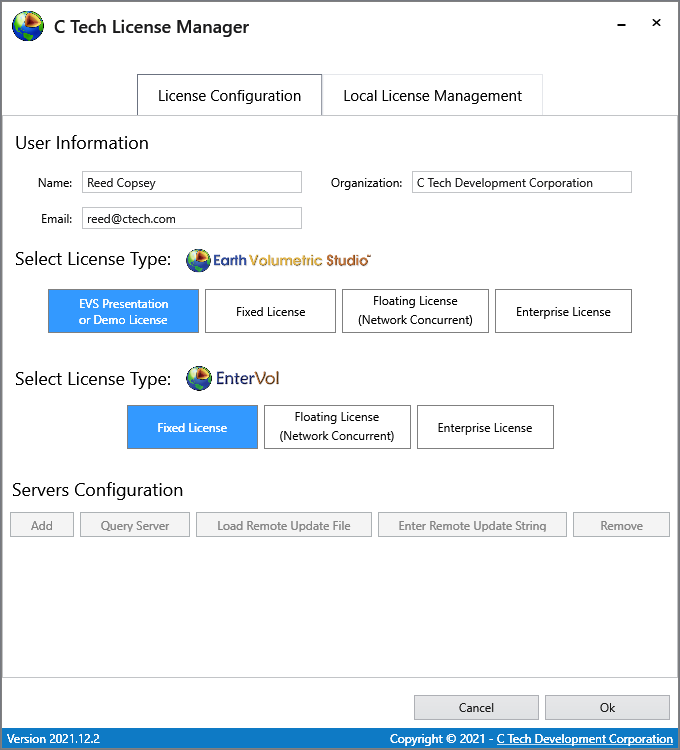
Below are the correct options for a Presentation and Demo License. Be sure to set your User and Organization name correctly, as this will be important in order to receive technical support in the future.
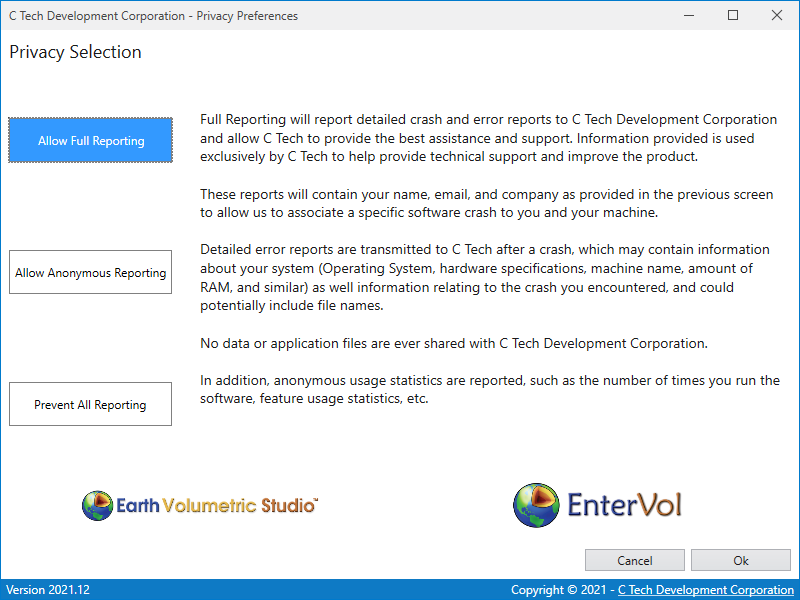
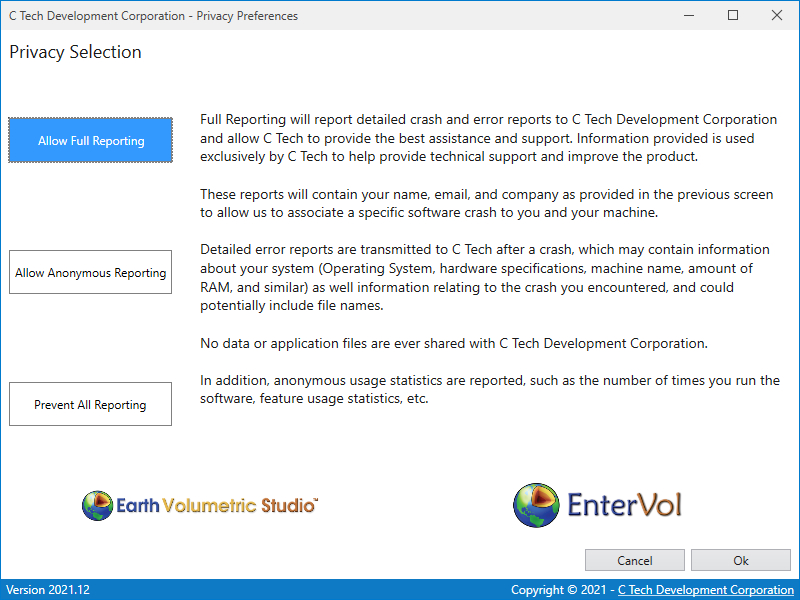
When you click OK on the window above, it will open the last C Tech License Manager window shown below. In this window we request your permission to send automated error reports to C Tech should you encounter a problem while using the software.
Tip
Allowing Reporting (especially Full Reporting) will allow us to provide you with a higher level of Technical Support should you encounter an unexpected problem.
Once the C Tech License Manager (shown above) is closed, it will not reopen unless you run it explicitly. Each time you start Earth Volumetric Studio, the options you have set above will apply.
Each user should install the latest versions available from the download site:
Earth Volumetric Studio
Earth Volumetric Studio Sample Projects
Warning
Installation requires Administrator rights.
Run each executable and follow the instructions to set your preferred install folder and options.
With all license types, the first step of client setup (after EVS software installation) is to set up the proper license type in the C Tech License Manager. The C Tech License Manager has many additional functions discussed in this topic.
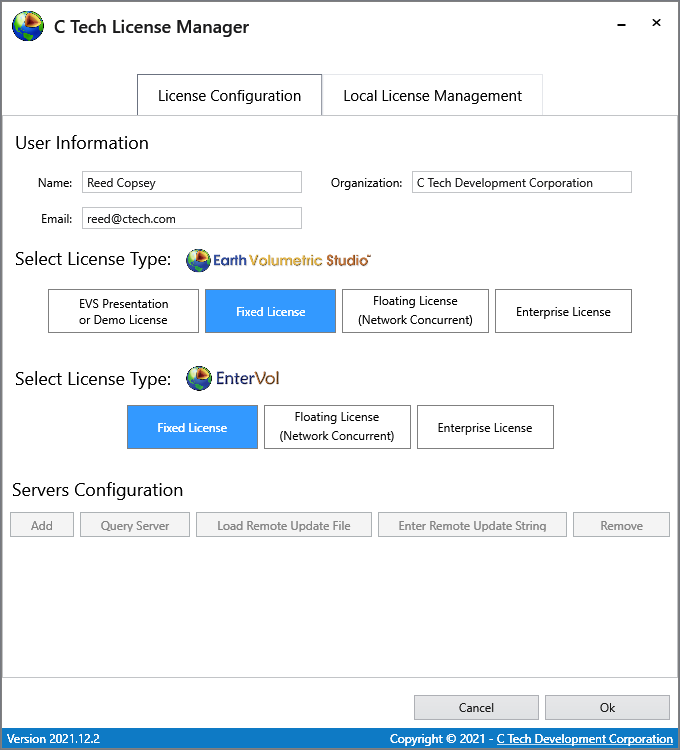
Below are the correct options for a Fixed (USB Dongle) License. Be sure to set your User and Organization name correctly, as this will be important in order to receive technical support in the future.
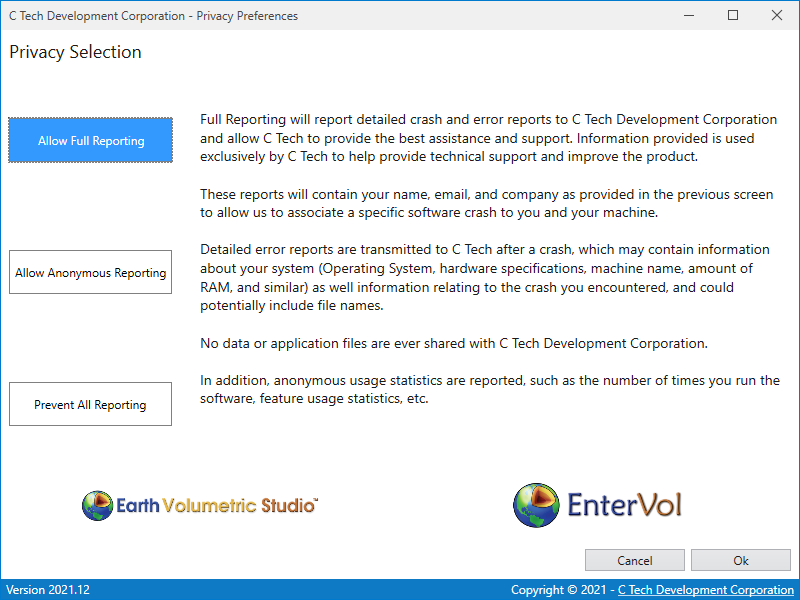
When you click OK on the window above, it will open the last C Tech License Manager window shown below. In this window we request your permission to send automated error reports to C Tech should you encounter a problem while using the software.
Tip
Allowing Reporting (especially Full Reporting) will allow us to provide you with a higher level of Technical Support should you encounter an unexpected problem.
Once the C Tech License Manager (shown above) is closed, it will not reopen unless you run it explicitly. Each time you start Earth Volumetric Studio, the options you have set above will apply.
C Tech Universal License Server Installation
C Tech employs a single license server which supports the following products:
Earth Volumetric Studio (EVS) Enterprise Licenses
Earth Volumetric Studio Floating Licenses
EnterVol Enterprise Licenses
EnterVol Floating Licenses
EnterVol Fixed Licenses
Info
EVS Fixed licenses do not require installation of the C Tech Universal License Server.
Installation of the C Tech Universal License Server will also install the C Tech License Manager. Installation of EVS and/or EnterVol will also install the C Tech License Manager.
Before Proceeding
Warning
The minimum versions supported are Windows 10 x64 and Windows Server 2019 x64.
Installation requires Administrator rights.
A system reboot may be required to complete the installation.
You must make sure that communication on TCP/IP Ports that we use are not blocked.
Port 9348 is used by Earth Volumetric Studio 2020 and future releases
Port 9346 is used by older Earth Volumetric Studio & MVS releases
Port 9347 is used by EnterVol components and EnterVol Suite
These ports are not user configurable; they are hard coded.
If you are an existing user, please ensure that you have uninstalled all pre-2020 versions of C Tech license servers, otherwise you will be forced to exit the installation. Please refer to Required Uninstalls of C Tech’s Legacy Servers for more information.
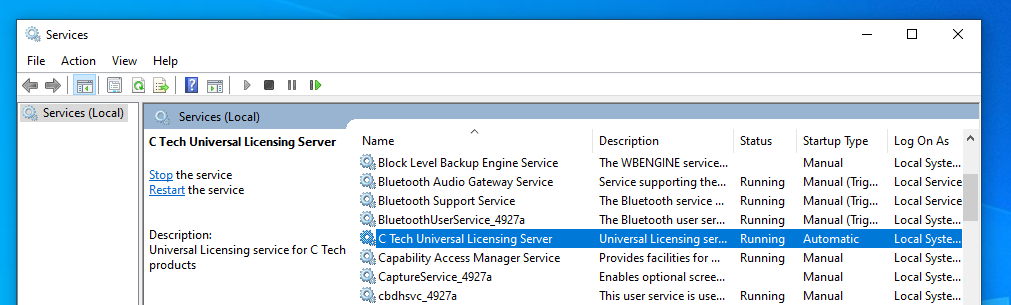
If these criteria are met, please proceed with the installation. After finishing the installation, you can verify that the C Tech Universal License Server was correctly installed and running with Windows Services Program:
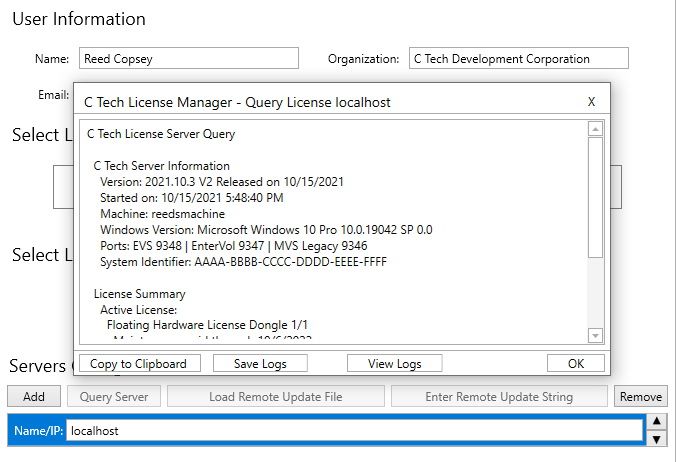
You should also verify that the C Tech License Manager can establish communication with the licensing server:
Cloud Server Installation For Enterprise Customers
We do have Enterprise customers who have successfully installed and operate the C Tech Universal License Server on platforms such as Azure and AWS.
This still requires the hardware dongles to be accessible via a USB port but other customers have successfully managed this using an AnywhereUSB device. Enterprise License dongles specifically do allow virtual machines to serve licenses to your users.
Info
Software based licensing is also available for cloud installation. Contact C Tech support for more information.
How to uninstall legacy C Tech license servers before installing the Universal License Server
Subsections of C Tech Universal License Server Installation
Required Uninstalls of C Tech's Legacy Servers
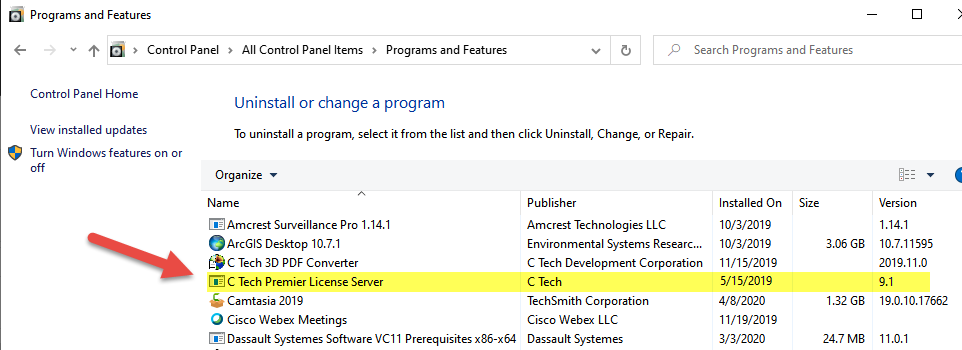
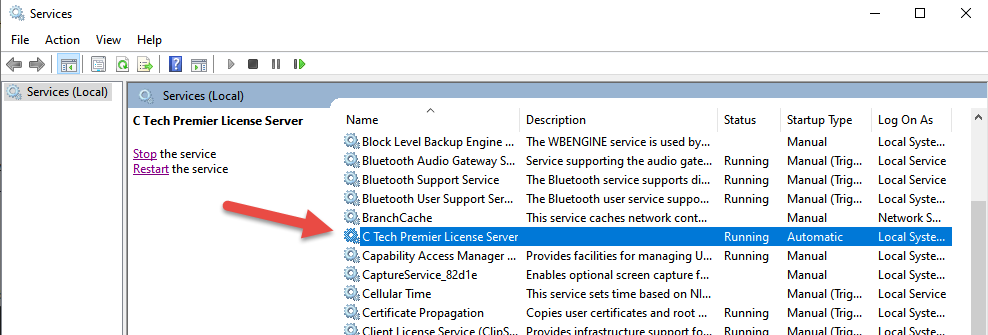
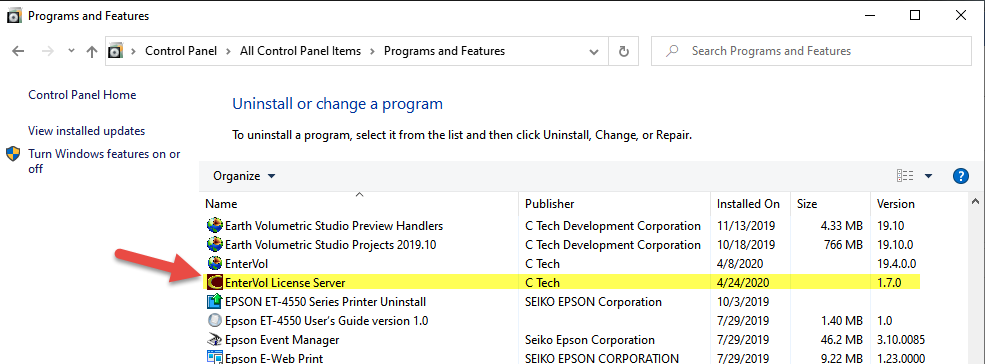
In Control Panel > Programs and Features, there are three legacy C Tech servers which you will need to Uninstall if they exist. These are:
1) C Tech Premier License Server
2) C Tech License Server (EVS / MVS Floating License Server)
3) EnterVol License Server
Warning
Since these are all Windows Services, they cannot be automatically uninstalled by the new C Tech Universal License Server and therefore must be uninstalled manually. The C Tech Universal License Server will not allow you to proceed with installation if any of the above three programs are installed.
C Tech License Manager (CTLM)
The C Tech License Manager comes bundled with most C Tech Products to facilitate license configuration and management. A standalone installer can also be downloaded from C Tech Development Corporation: Downloads.
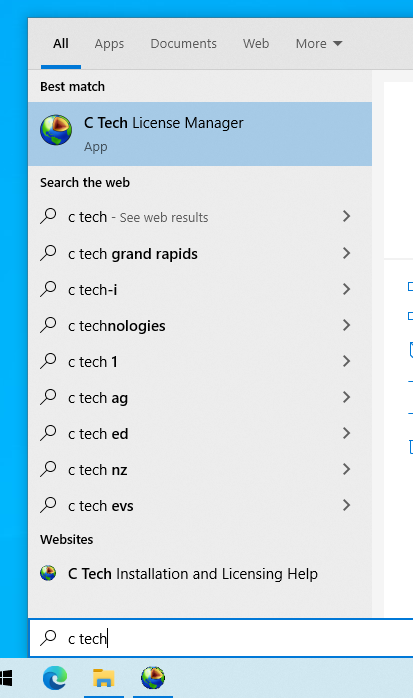
To launch, simply search for the C Tech License Manager entry in the Windows Start Menu:
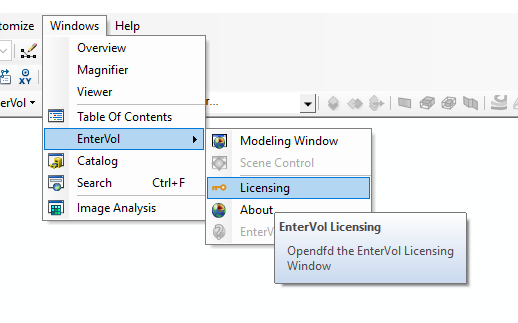
If you are using the C Tech License Manager to configure an EnterVol for ArcGIS license, you can additionally launch the License Manager from within EnterVol’s menus in ArcGIS (ArcScene).
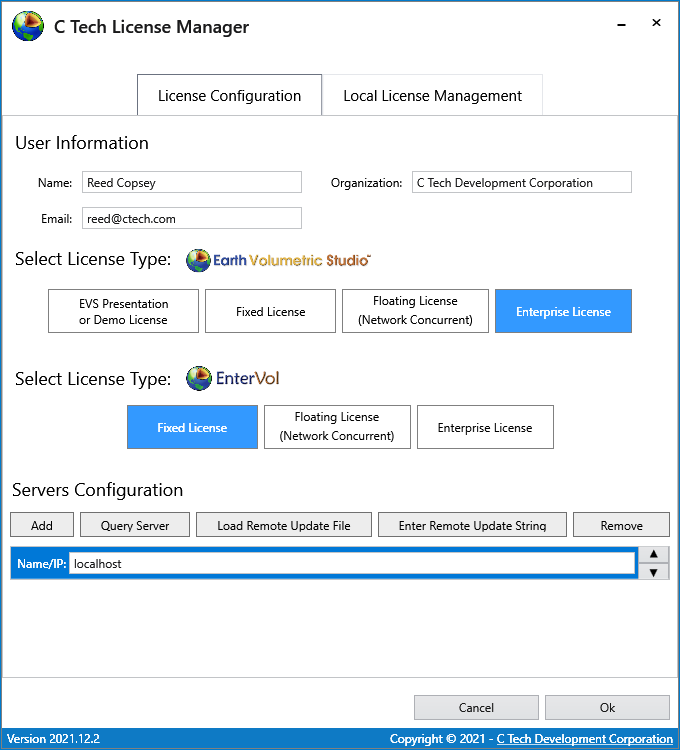
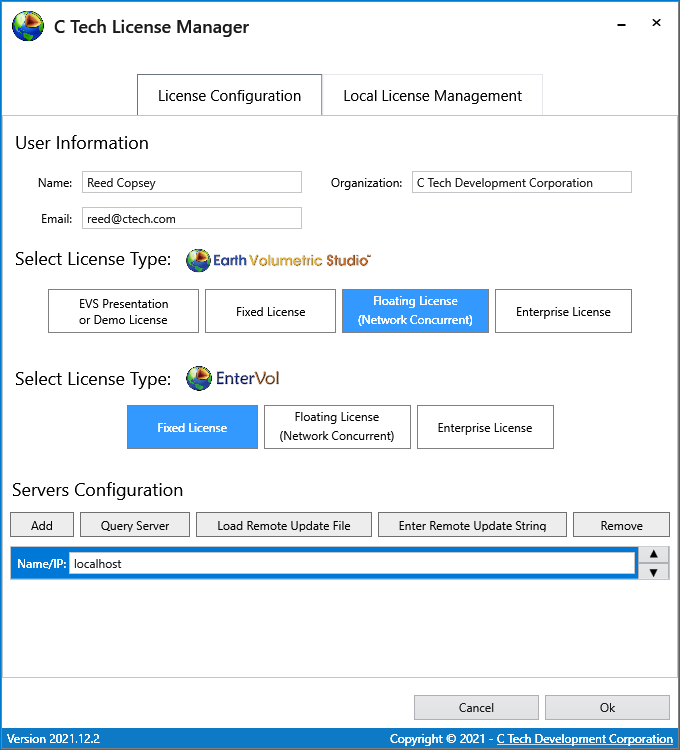
Once opened, you will see two different Tabs. The main section found under the “License Configuration” tab, lets the user provide their information, configure their product’s license, and configure any remote concurrent servers providing licenses. The second tab, “Local License Management” allows for verifying the status of local licenses as well as applying new software licenses and updates files (.ctupdate).
Common licensing issues and solutions for C Tech products
Subsections of C Tech License Manager (CTLM)
User Info & Server Configuration
License Configuration - User Information
Please enter the following:
For Name please enter the user name if on a client computer. If the license installation is on a server, please provide the name of the IT Administrator.
Organization name should be your company such as: ACME Geology, Inc.
Here you must select the appropriate license type for the product you have purchased. Choosing Floating or Enterprise licenses for EVS or EnterVol will activate the Servers Configuration section.
If you are using either EVS Demo or Fixed licenses, skip this step.
Server Configuration
If you have a remote license server installed and know the Server IP address or Hostname of the server, you can use the Servers Configuration section to specify the Name/IP for customers with Enterprise or Floating licenses. Also note that multiple servers can be configured to provide redundant licensing service should one or more primary servers go down.
There are several buttons here which provide important functionality. These are:
Add / Remove: Allow you to add or remove IP number or Hostname for your license server(s)
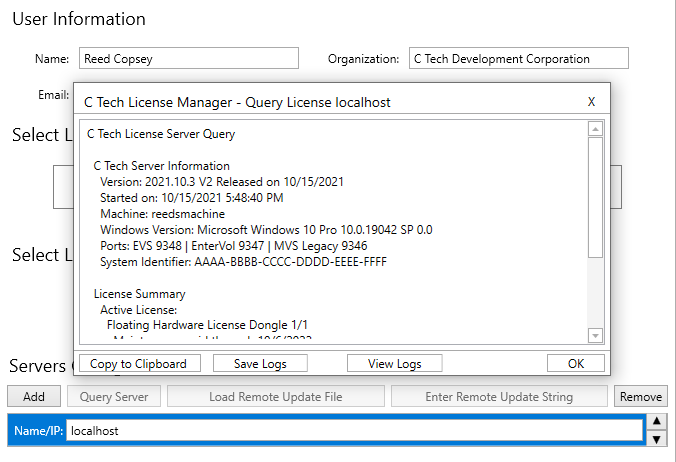
Query Server: Provides a quick way to find the status and/or confirm communication with the server.
Query will give you status of all Licenses on the remote server.
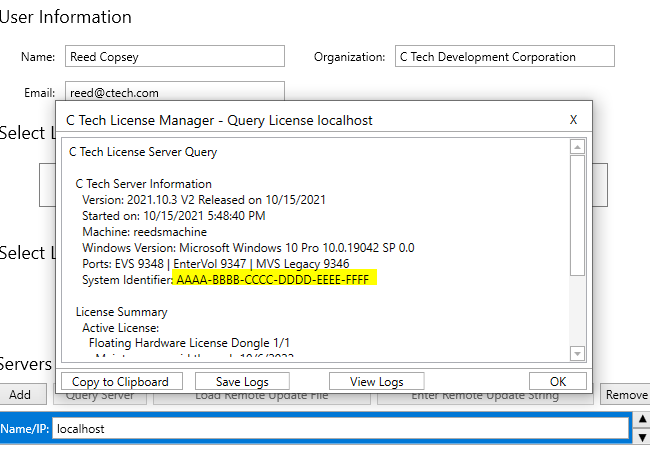
This also provides information about the remote system, including the System Identifier which is used for software licenses.
Load Remote Update File: If C Tech sends you a file with a .ctupdate extension intended to be installed on a remote server, use this option to apply the file.
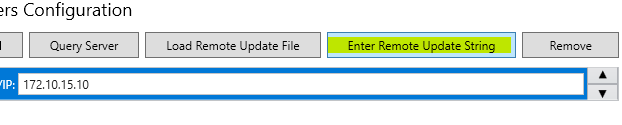
Enter Remote Update String: Same as Load Remote Update File but with a special format in cases where special handling is needed.
Local & Remote Dongle (Key) License Management
C Tech License File Updates provide a way to install and update licenses on both local and remote machines. The main functions of C Tech License File Updates include upgrading and/or updating C Tech USB License Dongles used by Earth Volumetric Studio licenses as well as installing C Tech Software Licenses for EnterVol for ArcGIS.
When no Enterprise Add-Ons are being added or dropped, a single update file can support the updating of your company’s entire set of USB Dongles. Otherwise, we will provide individual update files for each dongle (key). C Tech will send you a .ctupdate file through email (or other means if required) which you can use to apply the update or install a software license for products that support it. Please be sure to save this file to a location on the same machine as the C Tech License Manager installation, as you will need to load this file in the following steps.
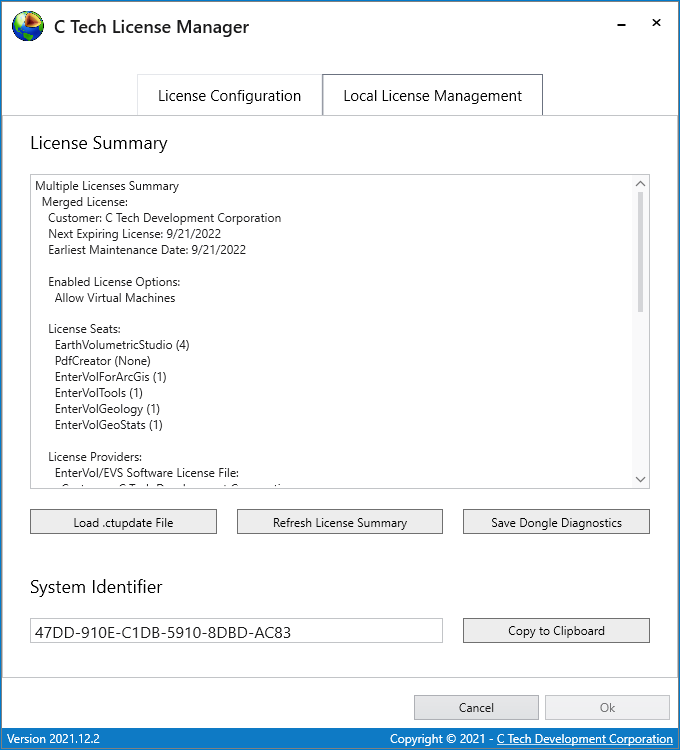
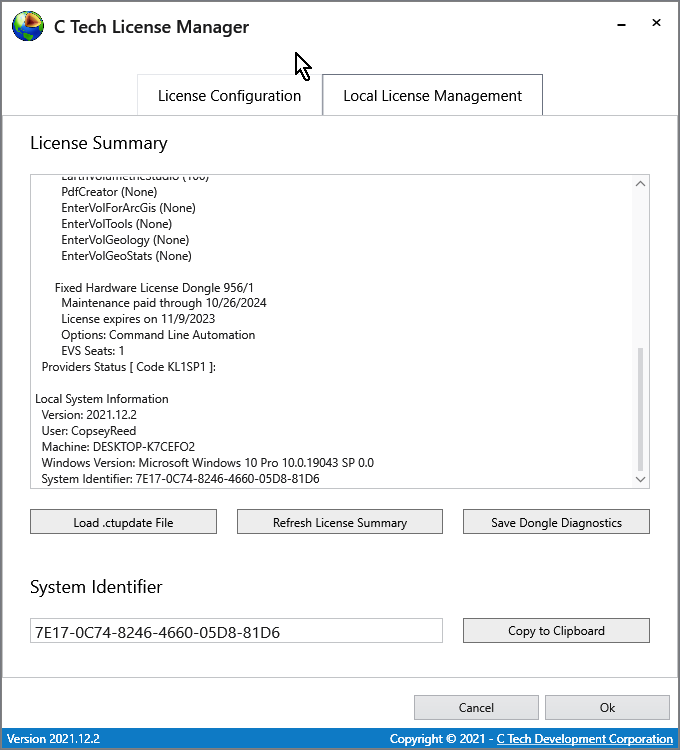
The Local License Management tab provides several important functions:
Load .ctupdate File: Allows you to load and apply a C Tech License Update File (.ctupdate) to Update or Upgrade existing license dongles (keys).
License Summary: Provides a summary of licenses installed on the local machine. Also shows information related to all licenses associated with C Tech USB Dongles.
Save Dongle Diagnostics: In cases where the dongle needs troubleshooting, this will prompt you to select a destination folder and will then generate a file containing diagnostics of all installed C Tech USB Dongles. If requested by C Tech support, please include all generated files as attachments for subsequent support emails.
Local Updates
For both license updates and license installations, if they are to be performed on the local workstation, then select the “Local License Management” tab in the C Tech License Manager, and click on the “Load .ctupdate File” button.
Warning
If your C Tech License Manager does not match the images in this topic, you are likely running an old version and need to install the latest version from https://client.ctech.com/.
You will be prompted to select the .ctupdate file emailed to you. Select the .ctupdate and the license manager will report the result of the local update and also show the status of the updated licenses in the Licenses Summary area.
Remote Updates
For both license updates and license installations, if they are to be performed on a remote server, then select the “License Configuration” tab in the C Tech License Manager, which should already be selected on first launch. Ensure that you have configured a server by clicking on the “Add” button and then entering the Name or IP of the server. See License Configuration > Configuring License Servers for more information. Then you may click on the “Load Remote Update File” button.
You will be prompted to select the .ctupdate from the computer’s file system. Select the .ctupdate file emailed to you. After a brief moment, the license manager will report the result of the remote update. To view the status of the server, you may now click on the “Query Server” on the same row as the previous button.
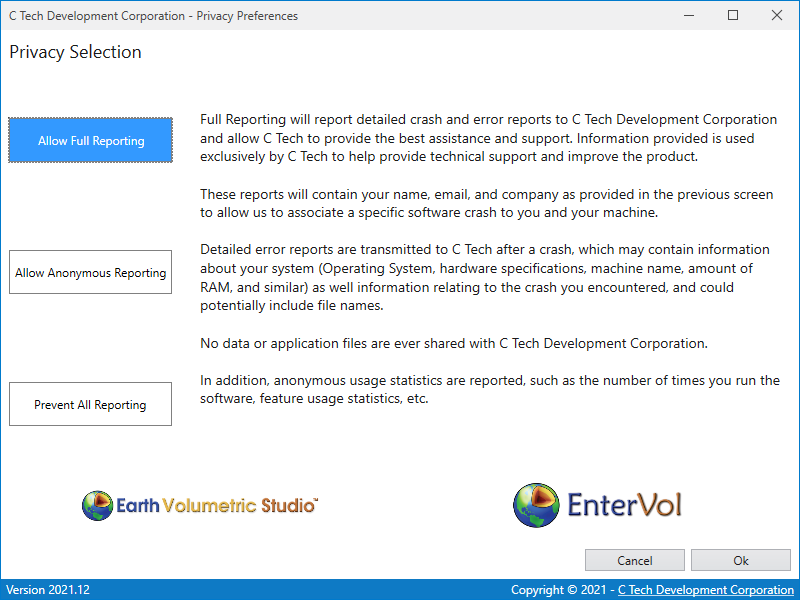
Privacy Selection
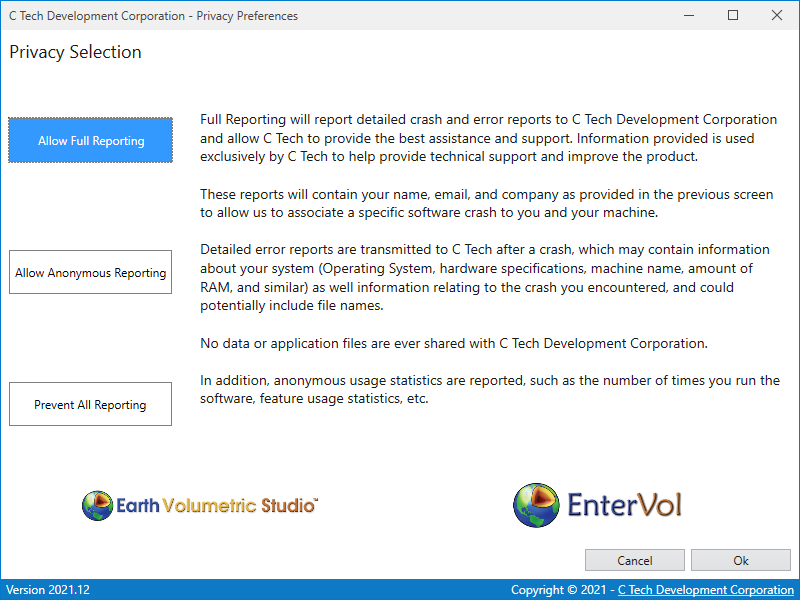
After the previously mentioned fields have been configured, you may press the Ok button at the bottom right, this will take you to the Privacy Selection window. You may choose between “Allow Full Reporting”, “Allow Anonymous Reporting”, and “Prevent All Reporting”. Please read the provided descriptions for each option in the Privacy Selection window for more information.
Tip
It is highly recommended to “Allow Full Reporting” since this can provide C Tech with information which may be crucial in debugging possible software errors or crashes.
Local & Remote Software License Management
C Tech License File Updates provide a way to install and update licenses on both local and remote machines. The main functions of C Tech License File Updates include upgrading and/or updating C Tech Software Licenses for EnterVol for ArcGIS.
The Local License Management tab provides several important functions:
Load .ctupdate File: Allows you to apply a C Tech License Update File (.ctupdate) to install a new software license for supporting products or update existing licenses.
License Summary: Provides a summary of licenses installed on the local machine, as well as (local) system information such as the System Identifier used by software based (vs dongle) licenses. Also shows information related to the license providers, whether they come from C Tech USB Dongles or from C Tech Software Licensing.
System Identifier: Unique Identifier that is unique to the local system. This is used for C Tech Software Licenses. Please refer to the following section for more info on Local Installation.
Save Dongle Diagnostics: In cases where the dongle needs troubleshooting, this will prompt you to select a destination folder and will then generate a file containing diagnostics of all installed C Tech USB Dongles. If requested by C Tech support, please include all generated files as attachments for subsequent support emails.
Local Updates
For both license updates and license installations, if they are to be performed on the local workstation, then select the “Local License Management” tab in the C Tech License Manager, and click on the “Load .ctupdate File” button.
Warning
If your C Tech License Manager does not match the images in this topic, you are likely running an old version and need to install the latest version from https://client.ctech.com/.
You will be prompted to select the .ctupdate file emailed to you. Select the .ctupdate and the license manager will report the result of the local update and also show the status of the updated licenses in the Licenses Summary area.
Remote Updates
For both license updates and license installations, if they are to be performed on a remote server, then select the “License Configuration” tab in the C Tech License Manager, which should already be selected on first launch. Ensure that you have configured a server by clicking on the “Add” button and then entering the Name or IP of the server. See License Configuration > Configuring License Servers for more information. Then you may click on the “Load Remote Update File” button.
You will be prompted to select the .ctupdate from the computer’s file system. Select the .ctupdate file emailed to you. After a brief moment, the license manager will report the result of the remote update. To view the status of the server, you may now click on the “Query Server” on the same row as the previous button.
Privacy Selection
After the previously mentioned fields have been configured, you may press the Ok button at the bottom right, this will take you to the Privacy Selection window. You may choose between “Allow Full Reporting”, “Allow Anonymous Reporting”, and “Prevent All Reporting”. Please read the provided descriptions for each option in the Privacy Selection window for more information.
Tip
It is highly recommended to “Allow Full Reporting” since this can provide C Tech with information which may be crucial in debugging possible software errors or crashes.
License Troubleshooting
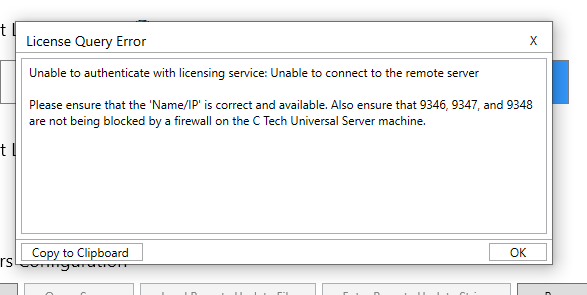
1) Unable to authenticate with licensing service
First ensure that the Name/IP that was provided in the Server Configuration is correct and accessible on your network. When running into this issue, the next most likely cause is that the required inbound TCP ports for the C Tech Universal License Server have not been configured to allow inbound network traffic.
Warning
Please ensure that the ports 9346, 9347, and 9348 are open and allow TCP network traffic on the machine where the C Tech Universal License Server is installed.
2) C Tech License Update File is corrupted
Please go back to the original email from C Tech which contains the update to verify that the files are the same. Sometimes email attachments may become corrupted by anti-virus or anti-malware tools. Please white list (protect) the file extension .ctupdate from being modified by any anti-virus or anti-malware tool.
When this remains an issue, the C Tech License Update may be provided in the form of an ASCII string which you can then use the “Enter Remote Update String” button in the C Tech License Manager to install a license or apply an update.
3) The dongle (key) you are trying to update may not have been included in the update
Please refer to the invoice from C Tech for a list of supported keys. If your dongle is not listed, it was not included in the update.
4) C Tech USB License Dongles are returning an error when attempting to do a local license update
For security reasons, the license dongles will sometimes not work when the machine is accessed via Remote Desktop Connection, as direct hardware access can be prevented by remote access software. In this case, use the alternate Server Configuration buttons to interact with the Name/IP set to “localhost”. This will apply updates to the local hardware.
EVS Floating or Enterprise License Client Installation
Installation of the latest version of Earth Volumetric Studio available from the download site
Installation of the latest version of Earth Volumetric Studio Sample Projects
Hostname or IP Access of the computer running the C Tech Universal License Server (with C Tech’s USB key attached).
THIS REPLACES “localhost” IN THE IMAGES BELOW unless you are installing a Floating or Enterprise license on your local computer (includes laptops), in which case the C Tech Universal License Server must be installed locally and configured as shown below.
Warning
Installation requires Administrator rights.
Run each executable and follow the instructions to set your preferred install folder and options.
With all license types, the first step of client setup (after EVS software installation) is to set up the proper license type in the C Tech License Manager. The C Tech License Manager has many additional functions discussed in this topic.
Below are the correct options for a Floating (USB Dongle) License.
Info
You need to enter Name, email and Organization of the User (if on a client computer) or the IT Administrator if on a server.
For Floating Licenses
For Enterprise Licenses
When you click OK on the window above, it will open the last C Tech License Manager window shown below. In this window we request your permission to send automated error reports to C Tech should you encounter a problem while using the software.
Tip
Allowing Reporting (especially Full Reporting) will allow us to provide you with a higher level of Technical Support should you encounter an unexpected problem.
Once the C Tech License Manager (shown above) is closed, it will not reopen unless you run it explicitly. Each time you start Earth Volumetric Studio, the options you have set above will apply.
Client Installation for EnterVol Concurrent or Enterprise Licenses
Installation of the latest version of EnterVol for ArcGIS available from the download site
Hostname or IP Access of the computer running the C Tech Universal License Server
Warning
Installation requires Administrator rights.
Run each executable and follow the instructions to set your preferred install folder and options.
With all license types, the first step of client setup (after software installation) is to set up the proper license type in the C Tech License Manager. The C Tech License Manager has many additional functions discussed in this topic.
If your organization has purchased EnterVol concurrent licenses and properly installed and configured the C Tech Universal License Server locally or on your network, you can follow the simple steps below to configure a client installation for a concurrent license.
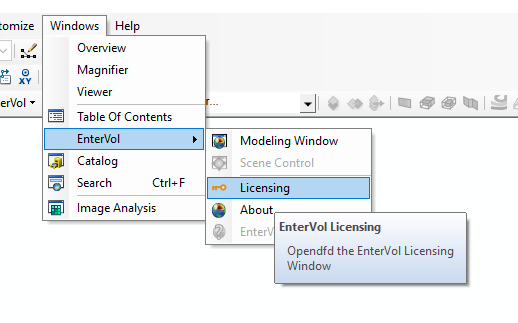
Launch the C Tech License Manager by clicking on the Licensing Option in the EnterVol menu entry under Windows > EnterVol > Licensing
If your client computer can connect to a valid server, your licensing window should show something like the above.
Requesting Enterprise Software or EnterVol Licenses
Enterprise EVS and EnterVol for ArcGIS users can use the C Tech Software License installed with a C Tech Universal License Server to provide licensing to its users. Unlike the C Tech USB License Dongle for Earth Volumetric Studio, these software licenses are locked to the machine’s hardware where the license server is installed.
Info
Fixed EnterVol Licenses use a locally installed C Tech Universal License Server and the “System Identifier” we require is on your local computer.
Concurrent and Enterprise Licenses use a remotely installed C Tech Universal License Server and the “System Identifier” we require corresponds to the server.
You will need to provide a “System Identifier” as well as additional information in order to receive a license file for a license that has been purchased and paid for. To obtain the “System Identifier”, please use the following instructions depending on where you have the licensing server configured.
Local Installation
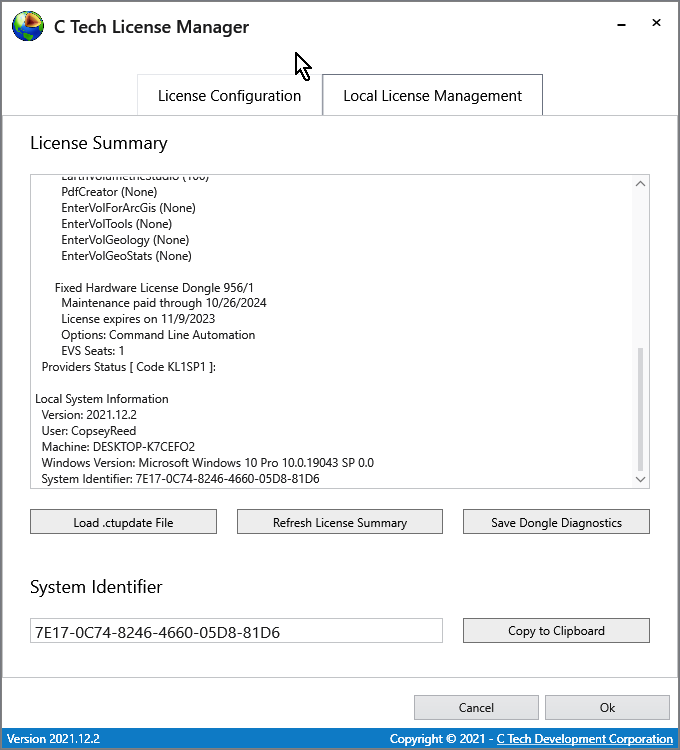
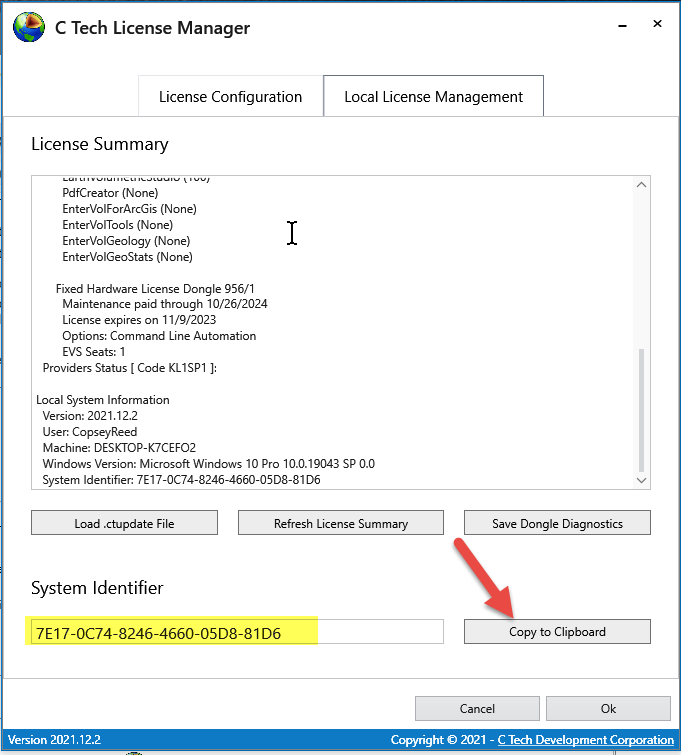
Select the “Local License Management” tab in the C Tech License Manager. There you will see at the bottom the System Identifier section. For your convenience you can click on the “Copy to Clipboard” button.
Remote Installation (On a different machine over the network)
From the “License Configuration” tab in the C Tech License Manager, ensure that a Server is properly configured.
When the connection to the server was successful, you will see the following window when you click the “Query Server” button.
Licensing Procedure
For Fixed, Concurrent and Enterprise License Customers, the licensing procedure is below.
EVS Enterprise and EnterVol Client-Server installations use the C Tech Universal License Server just as other EVS licenses do, but the license is locked to the server CPU, not to the USB dongle (key).
To request a license that has been purchased and paid for, you must do the following: