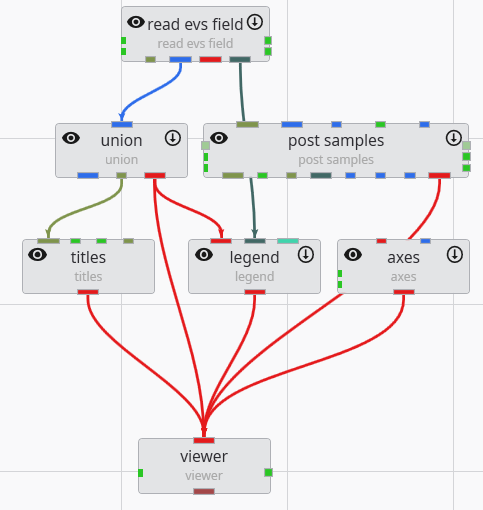
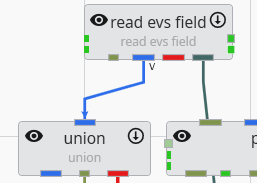
The Application Network is the primary workspace in Earth Volumetric Studio for building and managing your data processing workflows. It is a visual, node-based environment where you construct “applications” by placing modules and connecting them to define a data flow from input to final visualization.
Modules
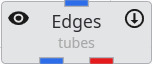
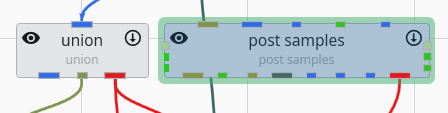
Modules are the fundamental building blocks of an application. Each module performs a specific task, such as reading data, performing a calculation, creating a geometric object, or rendering a scene. They are represented by rectangles on the Application Network, each stating a user-defined name and the module type under it. You add modules to your network by dragging them from the Module Library onto the Application Network canvas.
Each module has a set of icons that appear when you hover over it, providing quick access to key functions:
Icon
Description
Disable/Enable Module
Clicking this icon disables the module and any downstream modules that depend on it. A disabled module will not execute when the application is run. The icon appearance will change to quickly notice disabled modules. Clicking the icon again re-enables it and will make it run immediately.
Hide/Show Output
This icon is available on modules that produce a visual output. Clicking the eye icon toggles the visibility of that module’s output in all viewers.
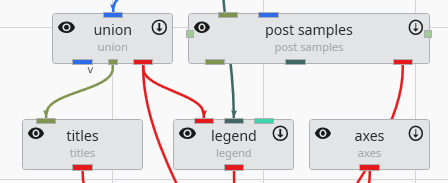
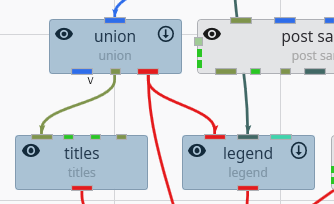
Modules communicate with each other through ports. Each module has one or more input ports (on the top) and output ports (on the bottom). You create Connections between modules which define the top-down Data Flow of the application, directing the output of one module to become the input for the next. See the Connecting and Disconnecting Modules topic.
Ports are color-coded to indicate the type of data they handle, and you can only connect ports of a similar color. While there are many port types, the two most critical and frequently used are Field ports and Renderable Object ports.
Connections can be removed by selecting the connection with the left mouse button in the Application Network and then either using the DEL key or by clicking the right mouse button and choosing the Disconnect option.
Module Right-Click Menu
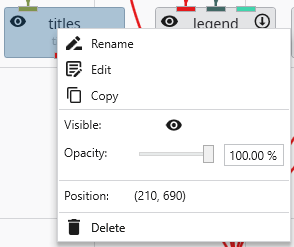
Right-clicking on any module in the Application Network opens a context menu that provides quick access to several common actions and properties for that module.
Option
Description
Rename
Allows you to change the display name of the module as it appears on the Application Network canvas.
Edit
Opens the selected module’s parameters in the Properties window.
Copy
Creates a duplicate of the selected module, including its current settings. The new module can be pasted with CTRL+V.
Visible
This toggle, represented by an eye icon, controls the visibility of the module’s output in the viewer (applies only to modules with a red output port).
Opacity
This slider and input box allow you to adjust the transparency of the module’s visual output in the viewer.
Position
Displays the read-only X and Y coordinates of the module’s top-left corner on the Application Network canvas.
Delete
Removes the module and all of its connections from the Application Network.
Input Port Context Menu
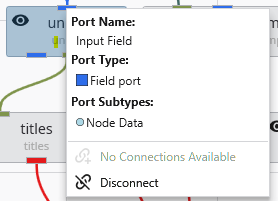
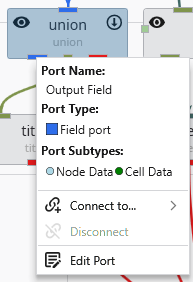
Right-clicking on a module’s input port opens a context menu providing details and actions for the incoming connection.
Option
Description
Port Name
Displays the name of the port.
Port Type
Shows the type of data the port accepts, indicated by a colored icon and a description.
Port Subtypes
Lists the specific kinds of data this port requires the output port to provide.
No Connections Available / Connect from…
Indicates if compatible output ports are available. If so, it allows you to create a connection.
Modules in the Application Network feature a set of icons directly on their surface that provide at-a-glance information and quick control over their execution and visibility. Modules that can be executed or produce a visible output have icons on their left and right sides. The right-side icon controls execution, while the left-side icon controls visibility in the viewer.
Modules in the Application Network display several visual cues to indicate their current status. These indicators help you quickly understand which module is selected, which is being edited, whether a module has run successfully, and if it is set to execute automatically. This allows for efficient management of your application’s workflow.
Selection and Editing Status The border of a module changes color to reflect its selection and editing state.
Modules in the Application Network are linked together by connections, which represent the flow of data from an output port of one module to an input port of another. Creating and removing these connections is fundamental to building and modifying your application’s workflow. The system helps ensure that you only make valid connections between compatible port types.
The color of the ports on a module provides an immediate visual cue about the type of data they accept or output. Understanding these colors and types helps in quickly assessing a module’s function and ensuring you are making valid connections within the Application Network.
Port Types Each port type is designed to handle a specific kind of data. The primary types are listed below.
Subsections of Application Network
Modules in the Application Network feature a set of icons directly on their surface that provide at-a-glance information and quick control over their execution and visibility. Modules that can be executed or produce a visible output have icons on their left and right sides. The right-side icon controls execution, while the left-side icon controls visibility in the viewer.
Execution Control
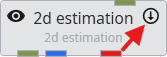
The icon on the right side of a module indicates its execution status. Clicking this icon toggles the module’s Run property, which is the same setting found in the Module Properties window.
State
Icon
Description
Run
The downward-pointing arrow signifies that the module is active. It will execute automatically whenever its properties change or when it receives new data from an upstream module.
Off
The pause symbol indicates that the module’s automatic execution is turned off. It will not run until it is manually triggered through the Run Once button in its Module Properties window or its status is toggled back to Run.
Visibility Control
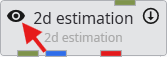
The icon on the left side of a module controls the visibility of its output in the 3D viewer. Clicking this icon cycles through the available visibility states, which is the same as the visibility icon in the Table of Content in the Viewer.
State
Icon
Description
Visible
The open eye indicates that the module’s output is currently visible in the viewer.
Hidden
The crossed-out eye indicates that the module’s output is hidden in the viewer.
Excluded
This special state also hides the output in the main EVS viewer. More importantly, it completely excludes the object from being exported to web formats (CTWS) or 3D PDFs.
Locked
This state ensures the module’s output is always visible. It is primarily used for web exports (CTWS), where it forces the object to be visible, overriding any user attempts to hide it.
Special Visibility States for Parent Modules
Modules that can have multiple renderable children connected to them (such as group_objects or sequence modules) can display combined visibility states if their children have different settings.
State
Icon
Description
Indeterminate
Shown when some connected children are Visible and others are Hidden.
Visible with Excluded Child
Shown when the parent is set to Visible, but at least one child is Excluded.
Hidden with Locked Child
Shown when the parent is set to Hidden, but at least one child is Locked.
Modules in the Application Network display several visual cues to indicate their current status. These indicators help you quickly understand which module is selected, which is being edited, whether a module has run successfully, and if it is set to execute automatically. This allows for efficient management of your application’s workflow.
Selection and Editing Status
The border of a module changes color to reflect its selection and editing state.
Status
Description
Selected Module (Darker Background)
When you single-click a module, it becomes selected, indicated by a darker background. You can select multiple modules at once (e.g., by holding Ctrl or Shift), and all will show this background.
Editable Module (Green Border)
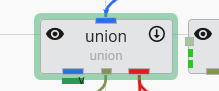
When you double-click a module, it becomes the single “editable” module, and its properties are displayed in the Properties window. This state is indicated by a thick green border. There can only be one editable module at a time.
Editable Port
If you double-click on a specific output port of a module, that port’s properties will be shown in the Properties window. The parent module will receive the green “editable” border to indicate it is the focus of the properties window.
Output Status
A key indicator of a module’s state is the presence or absence of a solid red bar along its bottom edge. This simple visual cue instantly tells you whether a module has successfully run and produced data that is available to downstream modules.
Status
Description
No Output (Red Bar Visible)
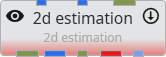
When a module displays a prominent red bar, it signifies a “No Output” state. This occurs if the module has not yet been executed or if it failed to generate any valid output. The red bar serves as a clear warning that downstream modules will not receive any data.
Has Output (No Red Bar)
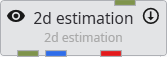
When the red bar is absent, it indicates a “Has Output” state. This confirms that the module has run successfully and its output data is ready and available for downstream modules.
Status in the Application Overview
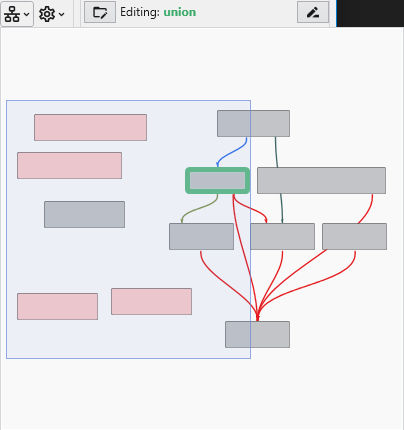
The Application Overview window also provides a simplified summary of module statuses, which is useful for monitoring complex applications. In the overview, you can still see which module is selected for editing (highlighted in green) and which modules have successfully run (those without the red “No Output” bar).
Modules in the Application Network are linked together by connections, which represent the flow of data from an output port of one module to an input port of another. Creating and removing these connections is fundamental to building and modifying your application’s workflow. The system helps ensure that you only make valid connections between compatible port types.
Creating Connections
There are two primary methods for connecting modules: dragging with the mouse or using the right-click context menu.
Method 1: Drag and Drop
This is the most common and intuitive way to connect modules.
In the Application Network, locate the output port on the source module that you wish to connect from.
Press and hold the left mouse button on the output port and begin dragging your cursor away from it. A line will appear and follow your cursor, originating from the port.
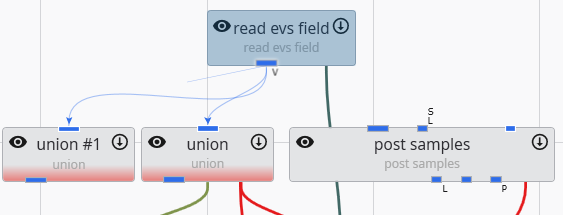
Drag the cursor towards the target module. While you keep the left mouse button down, all compatible input ports will be highlighted, indicating where a valid connection can be made. Incompatible ports will remain un-highlighted. This guidance behavior can be controlled in the Options page in the Menu.
Release the mouse button over one of the highlighted, compatible input ports. The connection will be established, and a solid line will now link the two ports.
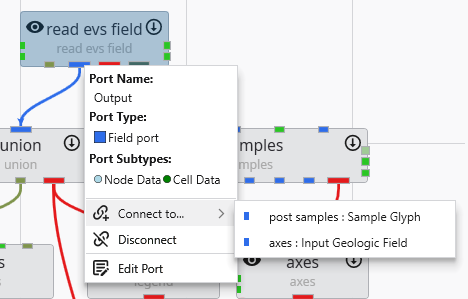
Method 2: Using the Context Menu
This method is particularly useful in complex applications where modules are far apart, making dragging impractical.
Move your cursor over the desired port (input or output) on the source module.
Click the right mouse button to open the port’s context menu.
Select the Connect to… option. This will typically open a sub-menu or a dialog window that lists all compatible ports available in the entire application.
Choose the target module and port from the list. The connection will be created automatically.
Removing Connections
You can remove existing connections using either a keyboard shortcut or the right-click context menu.
Method 1: Using the Delete Key
Move your cursor over the connection line you wish to remove. The line will highlight to indicate it is interactive.
Click the connection with the left mouse button to select it. A selected connection is typically indicated by a change in its appearance, such as becoming thicker or changing to a dashed line.
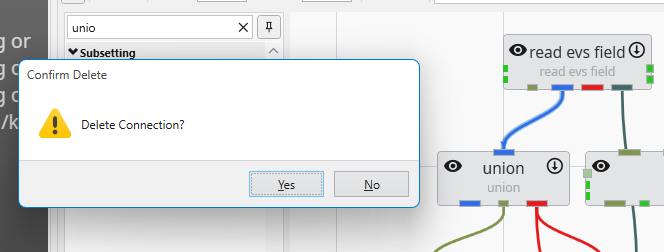
With the connection selected, press the Delete key on your keyboard. The connection will be removed if you confirm the warning that will pop up.
Method 2: Using the Context Menu
Move your cursor directly over the connection line you wish to remove.
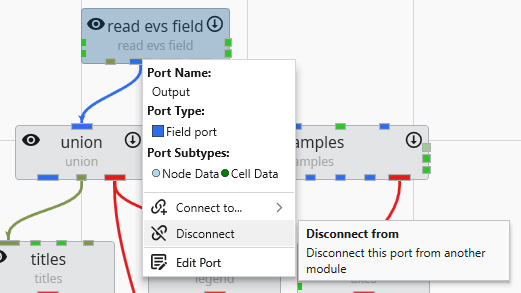
Click the right mouse button to open the context menu for that connection.
Select the Disconnect option from the menu. The connection will be removed immediately.
Once a connection is removed, the flow of data between the two modules is stopped. The downstream module will no longer receive updates from the upstream module and may enter a “No Output” state (indicated by a red bar) if it no longer has a valid data source. See Module Status Indicators.
Connection Style
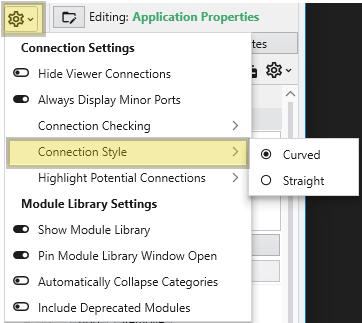
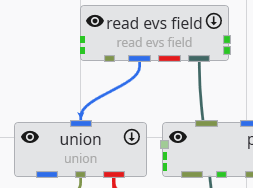
The Application Network provides flexibility in how the connections between modules are displayed. You can customize the visual style of these connections, choosing between direct, straight lines or smooth, curved lines. This setting allows you to tailor the appearance of your workspace for optimal clarity, which can be particularly helpful when working with complex applications where numerous connections might overlap.
Curved Connections:
Straight Connections:
The color of the ports on a module provides an immediate visual cue about the type of data they accept or output. Understanding these colors and types helps in quickly assessing a module’s function and ensuring you are making valid connections within the Application Network.
Port Types
Each port type is designed to handle a specific kind of data. The primary types are listed below.
Port Type
Color Name
Color
Description
Renderable Object
Red
This port handles renderable geometry and connects to the Viewer to display objects like isosurfaces, axes, or legends. It contains the fields, data, and rendering information necessary for visualization.
Field
Blue
This is the most common port type, used to pass datasets - such as grids with nodal or cell data - between the modules that create, subset, or modify them.
Realization Field
Light Blue
This is a special variant of the Field port used in stochastic modeling workflows to pass data for geostatistical realizations.
String
Olive Green
This port is used to pass text data, which can range from single words and phrases to full file names and paths.
Geologic Legend Information
Dark Green
This data port contains material names and related information from geology modules, often used to populate legends.
Vistas Data
Brown
This port is specifically used to pass geologic surface information to Groundwater Vistas for initializing MODFLOW models.
Number
Green
This port passes a single real number between modules.
Date-Time
Yellowish Green
This port passes date and time information.
View
Light Maroon
This port is an output from the viewer that passes the entire scene’s information, used by modules that export the viewer contents.
Port Subtypes
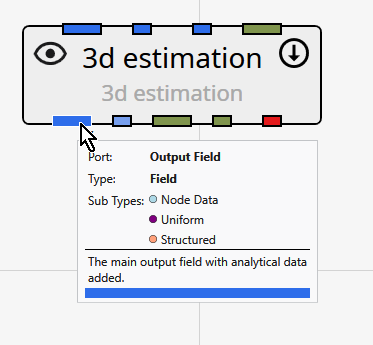
In addition to the primary colors, some ports feature one or more small colored dots. These dots indicate port subtypes, which provide more specific information about the data and enforce stricter connection rules. A connection is only valid if the output port includes all subtypes on the input port. This system prevents invalid connections, such as connecting a module that expects cell-based data to a port that only provides node-based data.
Below is an example of the output port for the 3d estimation module, which has three subtypes: Node Data, Uniform, and Structured.
The subtypes are grouped by their primary port category:
Category
Subtype
Color
Description
Field Subtypes
These subtypes describe the structure of the grid or the nature of the data within a Field object.
Geology
Goldenrod
Indicates that the field contains data representing geologic materials or stratigraphy, typically as integer material IDs.
Structured
Light Salmon
Indicates that the field is a structured grid, where the grid points are arranged in a regular, logical pattern (i.e., an i, j, k lattice).
Uniform
Purple
A more specific version of a structured grid, indicating that the spacing between grid points is constant along each axis.
Node Data
Light Blue
Indicates that the data values in the field are associated with the nodes (vertices) of the grid.
Cell Data
Green
Indicates that the data values in the field are associated with the cells of the grid.
Number Subtypes
These subtypes specify the intended use for a numeric value that is passed between modules.
Z Scale
Pink
Represents a numeric factor for vertical exaggeration, used to stretch or compress the Z-axis in the 3D viewer.
Explode
Gold
Represents a numeric factor that controls the “explode” distance, which separates components of a model for better visibility.
String Subtypes
These subtypes specify that the string data represents a path to a particular kind of file.
Filename
Blue
A generic file path.
Analytical File
Green Yellow
A path to a file containing analytical chemistry data.
Stratigraphy File
Light Goldenrod Yellow
A path to a file defining stratigraphic layers or surfaces.
Lithology File
Dark Gray
A path to a file defining lithologic materials and their properties.
Identifying Ports
To identify which port on a module corresponds to a specific item in the documentation, follow this order:
Input Ports are read from top to bottom on the left side of the module, then left to right on the top side.
Output Ports are read from top to bottom on the right side of the module, then left to right on the bottom side.
You can also hover your cursor over any port to see a tooltip with its name and data type details.